Contractor & Work Truck Parking in Eagle County: Where to Keep Trucks, Trailers & Equipment
Updated September 2026 Written by John Davis, Content Writer
A practical guide for contractors, trades, and service companies who need a secure place to keep work trucks, trailers, and equipment between jobs in Colorado's Eagle County, from Gypsum to Edwards to the Vail corridor.
Permit-Only Facility — Reserve Online
Commercial vehicle parking at Wins Parking is available by permit only, so the lot holds permit holders and no drive-up traffic. Payment confirms your reservation instantly, and each permit has a 3-month minimum, then renews in 3-month blocks until you cancel.
Eagle County, Colorado, is one of the most commercially active mountain counties in the American West. Anchored by Vail and Beaver Creek resorts, the I-70 corridor from Glenwood Springs to Vail Pass supports a year-round economy that depends on thousands of commercial vehicles — contractor trucks, service vans, equipment trailers, and fleet vehicles that keep the valley's infrastructure, hospitality, and real estate development industries running.
Yet commercial vehicle parking in Eagle County has historically been an afterthought. Municipal lots prohibit overnight commercial vehicles. Residential neighborhoods enforce HOA restrictions against work trucks. Resort areas restrict commercial vehicle access during peak hours. And airport terminal lots charge daily rates that make long-term fleet parking financially impractical.
This guide maps out the commercial vehicle parking landscape in Eagle County — where professional fleet parking exists, what it costs, what security infrastructure protects your vehicles, and how to choose the right facility for your operation.
The Commercial Parking Problem in Eagle County
Eagle County's parking infrastructure was built primarily for passenger vehicles — cars driving to ski resorts, tourists visiting mountain towns, and residents navigating daily life. Commercial vehicles were never part of the design equation. As the valley's economy has grown, this infrastructure gap has become a genuine operational challenge for businesses.
The towns of Vail, Avon, Edwards, Eagle, and Gypsum each have their own parking regulations, and most explicitly limit or prohibit commercial vehicle parking in public lots, residential streets, and commercial districts. Vail's strict vehicle size restrictions in the village core make it impossible to stage work trucks near job sites. Avon and Edwards enforce parking duration limits that prevent overnight commercial vehicle storage. Even Gypsum — the most commercially flexible town in the corridor — has limitations on where commercial vehicles can park long-term.
The result is that many commercial operators resort to improvised solutions: parking work trucks at employees' homes (risking HOA fines), staging vehicles on undeveloped parcels without permission (risking towing), or paying premium daily rates at airport and commercial lots designed for passenger vehicles. None of these approaches are sustainable for businesses that rely on fleet vehicles as core operational assets.
Dedicated Commercial Vehicle Parking Facilities
Wins Parking operates two purpose-built commercial vehicle facilities in Eagle County, each serving different geographic and operational needs within the I-70 corridor.
Eagle County Airport Fleet Parking — Gypsum
Located at 60 Spring Creek Rd in Gypsum, our airport-adjacent fleet parking facility is the primary commercial vehicle hub for the western half of Eagle County. Directly off I-70 Exit 140 and less than one mile from the Eagle County Airport (EGE) terminal, this facility serves as the staging point for fleets that need rapid deployment across the valley. Running a tractor-trailer? See semi truck parking in Gypsum.
The Gypsum facility is particularly well-suited for snow removal contractors, airport service companies, transportation operators, and any fleet that needs proximity to I-70 for east-west corridor access. The lot accommodates standard work trucks, cargo vans, pickup trucks with trailers, and oversized commercial vehicles. AI security cameras, license plate recognition entry/exit, and professional lighting provide 24/7 vehicle protection.
Edwards Stone Yard — Edwards
The Edwards Stone Yard at 33885 US-6 is a purpose-built contractor yard and heavy equipment staging facility in the heart of the mid-valley. Located between Beaver Creek and Vail, Edwards is the geographic center of Eagle County's luxury real estate and resort construction activity.
This facility handles heavy equipment that most parking lots cannot accommodate — excavators, front-end loaders, material haulers, and oversized construction trailers. It serves as a staging area for general contractors, subcontractors, and specialty trades working on projects from Bachelor Gulch to Vail Village. The yard's direct US-6 and I-70 access makes morning deployment to job sites across the valley efficient.
Choosing Between Gypsum and Edwards
Gypsum (Airport Lot)
- Best for western Eagle County jobs
- Airport & transportation fleets
- Direct I-70 Exit 140 access
- Standard vehicles & work trucks
Edwards (Stone Yard)
- Best for resort corridor jobs
- Heavy equipment & contractors
- Central Vail/Beaver Creek access
- Equipment staging & storage
Some operators split their fleet between both locations to minimize deployment time across the full corridor.
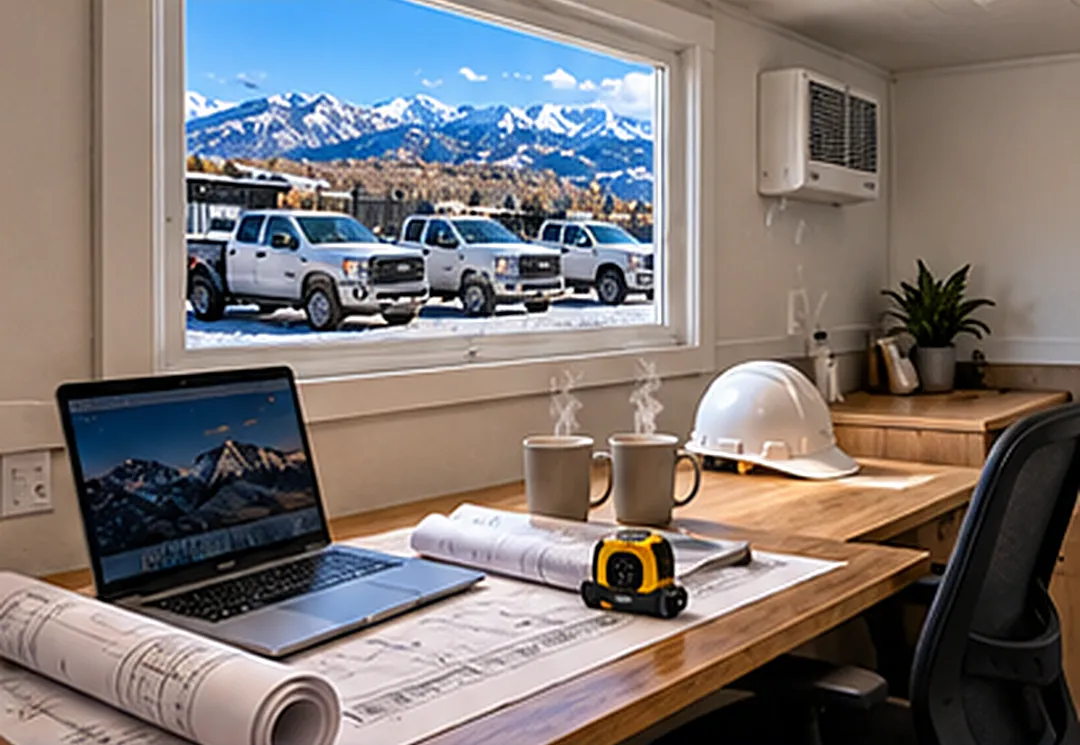
Your crew's office and 5 truck spaces
$1,595 a monthfounding rate, 12-month termRegular price $1,950
- Private 20-ft lockable office
- 5 reserved truck spaces beside it
- Trailers welcome
- Gated, camera-monitored, plowed all winter
Next to Eagle County Airport, across the street from its entrance. Private lot, not affiliated with Eagle County or the Eagle County Regional Airport.
What Does Contractor Parking Cost in Eagle County?
Contractor and work truck parking at Wins Parking is a flat monthly permit priced by vehicle size and fleet volume, so crews that commit more vehicles pay less per space. Every rate is all-in, with taxes and fees included. Here's the current price list for the Gypsum lot; at the Edwards Stone Yard, businesses rent a whole yard zone from $1,250 a month instead:
| Vehicle Type | 1–5 Vehicles | 6–15 Vehicles | 16+ Vehicles |
|---|---|---|---|
| Standard (work trucks, vans, pickups) | $210/mo | $195/mo | $180/mo |
| XL (box trucks, trailers, equipment rigs) | $265/mo | $245/mo | $225/mo |
| Semi truck (tractor + trailer) | $795/mo flat | ||
The three-month minimum commitment applies across all vehicle types, and permits start on a 3-, 6- or 12-month initial term, then renew in 3-month blocks until you cancel. Cancel anytime. Service runs to the end of your current term. Security deposits are standard but can be reduced or waived for commitments of six months or longer. All pricing includes LPR-based entry/exit, AI security monitoring, and a dedicated account manager; Gypsum permits and Edwards Stone Yard zones include 24/7 access.
Eagle County Commercial Parking Regulations
Understanding local parking regulations is essential for fleet operators in Eagle County. Each municipality enforces different rules regarding commercial vehicle parking, and violations can result in fines, towing, and complications with business licensing.
Vail restricts commercial vehicle access in the village core and residential neighborhoods. Vehicles over 22 feet in length are prohibited from most public parking areas. Construction vehicles must obtain specific permits for job-site staging, and overnight commercial parking in public lots is not permitted.
Avon enforces 72-hour parking limits in most public lots and restricts commercial vehicle parking in residential zones. The town's development around Beaver Creek creates steady contractor demand but limited legal parking options for work vehicles.
Edwards has comparatively relaxed commercial vehicle regulations, reflecting its role as the valley's commercial hub. However, US-6 corridor parking is still regulated, and long-term commercial vehicle storage on undeveloped parcels requires landowner permission and may trigger county zoning review.
Gypsum offers the most flexibility for commercial vehicle parking due to its industrial and airport-adjacent zoning. The area around Eagle County Airport is zoned for commercial and light industrial use, making it the natural location for professionally managed fleet parking facilities.
Eagle County (unincorporated) regulates commercial vehicle parking through its land use code. Parking commercial vehicles on residential properties is generally restricted, and storing vehicles or equipment on undeveloped land without a proper use permit can result in code enforcement action.
Security Considerations for Commercial Vehicles
Commercial vehicle theft and equipment theft are not abstract risks in Eagle County. Construction equipment, tools, and work vehicle components are high-value targets, and the valley's seasonal workforce turnover creates security challenges that permanent residents don't always appreciate.
A professionally managed fleet parking facility with smart parking systems addresses these risks through layered security: AI cameras with motion detection and anomaly alerts, license plate recognition that logs every vehicle entry and exit, professional lighting that eliminates blind spots, and centralized monitoring that provides fleet managers with real-time visibility into their vehicles' status.
Insurance is another consideration. Many commercial auto policies require that fleet vehicles be stored at a designated, secured facility to maintain full coverage. Parking work trucks at residential addresses or on unimproved parcels may create coverage gaps that only surface after a loss event — exactly when you need your insurance most.
Where Should Contractors Stage Trucks Along I-70?
Eagle County's geography makes parking location strategy critical for commercial fleet operators. The valley stretches roughly 60 miles along I-70 from Glenwood Springs to Vail Pass, with job sites distributed across small towns, resort areas, and residential communities throughout. Where you stage your fleet directly impacts daily deployment efficiency, fuel costs, and crew productivity.
Wins Parking's two facilities create a strategic two-point coverage model for the corridor. The Gypsum airport lot covers the western corridor — Gypsum, Eagle, Dotsero, and Glenwood Springs — while the Edwards Stone Yard covers the eastern resort corridor — Edwards, Avon, Beaver Creek, and Vail. Operators with large fleets can split vehicles between both locations to minimize dead miles regardless of where the day's work takes them.
This guide stays focused on contractors, trades, and service fleets. If you drive or dispatch semi trucks or long box trucks over Vail Pass, read the semi truck parking guide for Colorado's I-70 corridor, which covers trailer clearance, reinforced surfaces, the Colorado chain law, and closures. Landowners near a freight route can read how a truck parking lot works as a business.
Getting Started with Commercial Vehicle Parking
Whether you need parking for two work vans or twenty contractor trucks, securing professional fleet parking in Eagle County starts with a simple conversation about your operational needs. Call (970) 279-1744 or complete the form below to discuss your fleet size, vehicle types, preferred location, and timeline. Same-day facility walkthroughs are available at both the Gypsum and Edwards locations.
For operators new to Eagle County — whether you're a national contractor starting a local project or a startup service company launching operations — Wins Parking's fleet program provides the professional parking infrastructure you need without the overhead of leasing commercial land or building your own facility. Start parking within 24–48 hours of signing, with full LPR access for your entire fleet from day one.
Frequently Asked Questions
Where can contractors park work trucks and equipment in Eagle County, Colorado?
Wins Parking runs two permit-only yards: the Edwards Stone Yard at 33885 US-6 in Edwards, in the middle of the resort construction corridor, and the lot at 60 Spring Creek Rd in Gypsum, across from Eagle County Airport. Both have license plate recognition gate access, cameras, lighting and year-round snow removal. Gypsum permits and Edwards Stone Yard zones include 24/7 access.
What vehicles and equipment can a contractor keep at the yards?
Work trucks, service vans, pickups with trailers, box trucks, landscaping rigs, snow plows and oversized equipment trailers. The Edwards Stone Yard is set up for contractor staging, and every vehicle is registered to the permit by license plate.
How much does contractor and work truck parking cost in Eagle County?
Standard spaces are $210 per month for 1 to 5 vehicles, $195 for 6 to 15 and $180 for 16 or more. XL spaces for box trucks, trailers and equipment rigs are $265, $245 and $225 by the same tiers, and semi-truck spaces are $795 per month flat. These per-vehicle rates apply at the Gypsum lot; at the Edwards Stone Yard a business rents a whole yard zone from $1,250 a month. Every rate is an all-in monthly price with taxes and fees included, and every permit is billed monthly on a 3-, 6- or 12-month initial term, then renews in 3-month blocks until you cancel. Cancel anytime. Service runs to the end of your current term.
Can crews pick up and drop off trucks before dawn or late at night?
Yes, at both lots: permit holders at Gypsum and zone holders at the Edwards Stone Yard have 24/7 access through license plate recognition, so crews can roll out before sunrise and return after dark without keys, cards or an attendant.
Is there contractor parking near Vail and Beaver Creek?
Yes. The Edwards Stone Yard at 33885 US-6 sits between Vail and Beaver Creek with direct US-6 and I-70 access, so crews working Edwards, Avon, Beaver Creek and Vail can stage close to their job sites.
I drive a semi truck through the I-70 corridor. Is this the right guide?
This guide is written for contractors and service fleets. Semi-truck drivers and fleet managers should read the semi truck parking guide at /semi-truck-parking-colorado, which covers the $795-per-month semi rate, trailer clearance, the Colorado chain law and I-70 closures.