Wins Parking Supplies
Traffic cones for parking lots, crews and events
For work zones on public roads, the MUTCD calls for cones at least 28 inches tall on freeways and other high-speed roads, with retroreflective bands for night use. Inside a parking lot, 28-inch cones in the 7-pound weight class are the common all-round choice. Count cones by the length of the closure and your spacing; the calculator on this page does it in feet. We stock cones at our Gypsum, Colorado yard and sell them to businesses by the pallet of 125.
For businesses. Minimum order: one lot, or the listed minimum on each product. Ships to the lower 48 states.
Traffic cones
Traffic Cones in the store
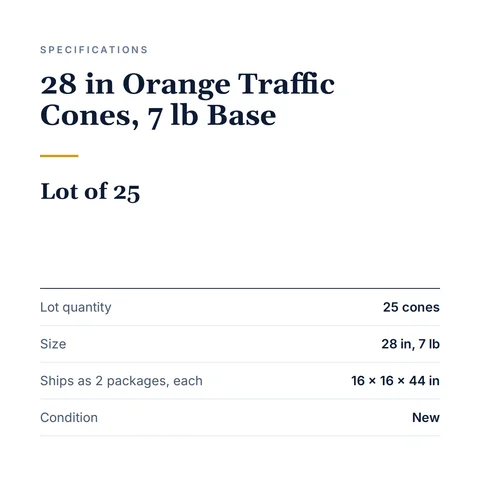
28 in Orange Traffic Cones, 7 lb Black Base, Bulk Lot of 25 – New
Pack of 25 · Freight
$12 / cone
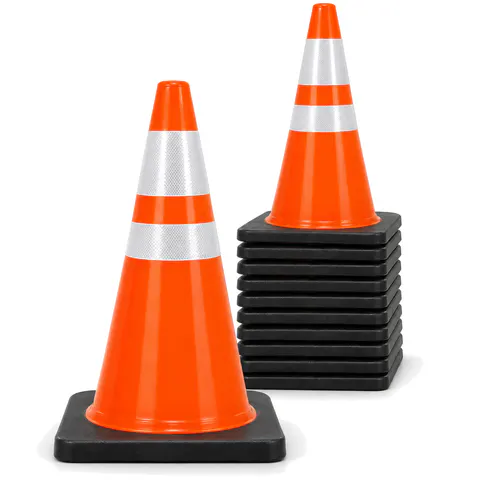
28 in Reflective Traffic Cones, Orange with Black Base, Bulk Pallet of 125 – New
Pack of 125 · Freight
$13.80 / cone
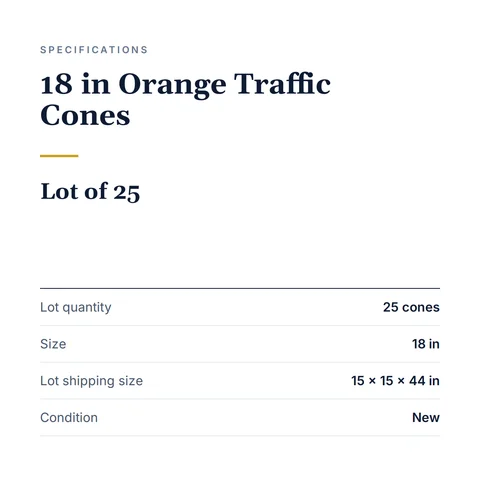
18 in Orange Traffic Cones with Black Base, Bulk Lot of 25 – New
Pack of 25 · Freight
$9.70 / cone
Calculator
Work out how many you need
Cones per linear foot
12 cones
5 in the taper, 7 along the closure
Spacing follows the MUTCD rule of thumb: in the taper, about 1 foot per mph of speed; along the closure, about 2 feet per mph. Confirm your work-zone plan.
Planning a whole lot? Use the lot kit builder.
Buyer's guide
Buying traffic cones: what an operator checks
How many cones per linear foot of closure
MUTCD guidance spaces channelizing devices no farther apart, in feet, than 1 times the speed limit in mph along a taper and 2 times the speed limit along the straight (tangent) section. At a 10 mph lot speed that is a cone every 10 feet in the taper and every 20 feet along the closure; at 25 mph it is every 25 and 50 feet.
So a 200-foot aisle closure at 10 mph, with a 50-foot taper, takes 11 cones along the closure and 6 in the taper, about 17 cones. Add a few spares for crews and for the cones that walk away.
Cone heights and weights
18-inch cones suit low-speed, short-term marking inside a lot and are easy to stack in a truck. 28-inch cones are the standard for road work and anything with traffic moving faster, and they are easier to see over car hoods. 36-inch cones add visibility on busy roads.
Weight decides whether a cone stays put. Heavier bases stand up to wind and passing trucks; lighter ones are easier to carry. Each product page lists the height, base weight and collar.
Using cones and reflective collars
For night use on roads, the MUTCD calls for retroreflective bands on cones. Collars slip over cones that don't have bands built in. In wind, a cone weight ring or a second cone stacked on the first keeps the line in place. Set cones from the upstream end and pick them up in reverse, so the crew is always behind the line.
Asphalt versus concrete
Cones sit on any surface and need no hardware. On smooth concrete, a heavier base resists sliding; on rough or sloped asphalt, check that each cone stands upright before traffic reaches it.
Pallet counts and freight basics for cones
Cones nest, so a pallet holds a lot of them, but the pallet is bulky for its weight, which puts it in a higher freight class than dense items. Our cones are Gypsum yard stock; the product page shows pack size, pallet quantity and shipping class.
LTL (less-than-truckload) carriers price a pallet by its weight, its size and its freight class. Freight class runs from 50 to 500 and is set mostly by density, in pounds per cubic foot: dense, heavy pallets ship at a lower class than light, bulky ones. Your delivery address matters too. A liftgate, a residential or limited-access address, or a call-ahead appointment each add a carrier charge. Our store quotes it live at checkout from the carriers, with those options priced in.
Common cone mistakes
What goes wrong most often:
- Using short cones where traffic moves faster than walking pace.
- Spacing cones so far apart that drivers read the gaps as lanes.
- No reflective collars on cones left out after dark.
- Light cones in wind, which end up in the next aisle.
When cones are required
Work zones on public roads follow the MUTCD and your state's version of it, plus any permit conditions from the city. In a private lot, cones are how you close an area while paint cures, a crew works or an event loads in. Your insurer or your contract may also require them.
Sources
Written by the Wins Parking operations team from the lots we run. Codes change and vary by city and state, so confirm local code before you install.
Freight and pallets
LTL (less-than-truckload) carriers price a pallet by its weight, its size and its freight class. Freight class runs from 50 to 500 and is set mostly by density, in pounds per cubic foot: dense, heavy pallets ship at a lower class than light, bulky ones. Your delivery address matters too. A liftgate, a residential or limited-access address, or a call-ahead appointment each add a carrier charge. Our store quotes it live at checkout from the carriers, with those options priced in.
From an operator
Free layout review
Send us the site address, stall count and a photo or plan. A Wins operator looks at the layout and sends back a supplies list and any striping or signage questions to raise with your local code office. No cost, no obligation.
Q&A
Questions buyers ask
How many traffic cones do I need per foot?
MUTCD guidance spaces cones no farther apart, in feet, than 1 times the speed limit in mph along a taper and 2 times along the straight run. At 10 mph that is every 10 feet in the taper and every 20 feet along the closure.
What size traffic cone is standard?
28 inches is the standard for road work and the common choice for parking lots. The MUTCD calls for at least 28 inches on freeways and other high-speed roads.
Do traffic cones need reflective collars?
For night use on roads, the MUTCD calls for retroreflective bands. Inside a private lot it's still the safer choice after dark.
Can I buy traffic cones by the pallet?
Yes. Cones are stocked at our Gypsum, Colorado yard and sold by the pallet of 125. For larger orders, ask for volume pricing at (970) 279-1744 or reserve@winsparking.com.
How much does a 28-inch cone weigh?
It depends on the base. Our product page lists the base weight of each cone we stock; heavier bases stay put in wind.
Do you ship traffic cones nationwide?
We ship to the lower 48 states. Freight is quoted live at checkout from UPS, FedEx and LTL carriers to the lower 48. Business addresses with a dock get the lowest rate. Liftgate and residential delivery are priced at checkout. Orders ship in 1–2 business days and arrive in 3–6 business days after shipping.
Add QR pay signs with Park Graph
Park Graph, operated by Wins Parking, LLC, lets owners collect parking payments by QR sign, with no app for drivers and no meter or kiosk on site. Pair it with the signs and posts you order here.
Related
Often ordered with
Ready to Unlock Your Parking Revenue?
Request a proposal. Tell us about your property and we'll show you what's possible.
Prefer to talk? Call or text 877-713-WINS (877) 713-9467 or (970) 279-1744